
September 17, 2026 · Mock Interview Training Team
How CV-based interview questions improve mock practice
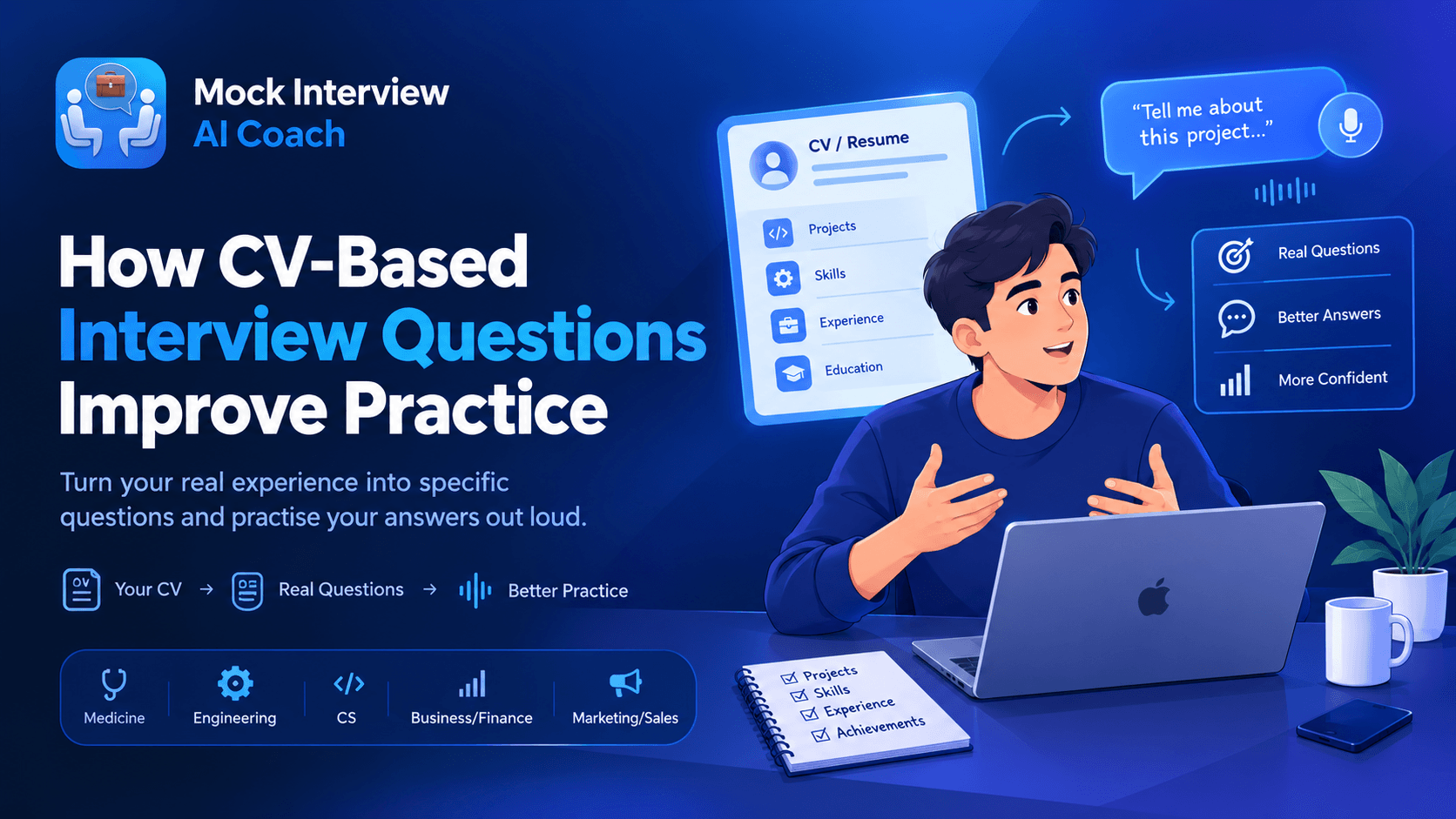
Interviewers often use your CV as the starting point for questions because every line represents something you have claimed about your experience. If you want more useful mock interview practice, prepare from your actual CV rather than relying only on generic questions.
A strong CV gets you into the conversation, but it also gives the interviewer plenty to ask about. A project, job title, technical skill, clinical placement, sales result, or career gap can quickly become a follow-up question. The goal is not to memorise your CV. It is to explain the important parts of it naturally, with enough detail to show what you actually did.
1. Why interviewers ask questions from your CV
Generic interview questions tell an interviewer relatively little about your specific experience. Your CV gives them something concrete to investigate.
If you write that you "led a project," they can ask what you personally led. If you list Python, they can ask where you used it. If you mention improving a process, they can ask what changed and how you measured it.
Think of every significant CV entry as a claim that you should be prepared to explain.
Common CV-based interview questions include:
- "Walk me through what you did in this role."
- "Tell me more about this project."
- "What was your specific contribution?"
- "What was the most difficult part of this work?"
- "Why did you leave this position?"
- "Why is this particular tool or skill on your CV?"
- "What would you do differently now?"
- "Can you explain this gap between these two roles?"
This is why simply reading your CV before an interview is not enough. You need to turn written claims into spoken explanations.
2. Know which parts of your CV are most likely to be challenged
You do not need to prepare a five-minute answer for every line. Start by auditing the document.
Read your CV as if you were the interviewer and highlight six to eight items that invite follow-up questions.
Look especially closely at:
- Projects with measurable results
- Skills or tools that are important to the role
- Leadership or ownership claims
- Short jobs or internships
- Major career changes
- Gaps in employment or education
- Promotions or changes in responsibility
- Claims involving numbers, performance, or improvement
For each highlighted item, ask yourself three questions:
- What exactly does this claim mean?
- What did I personally do?
- What would I say if someone asked me to prove or explain it?
That last question matters. You are not trying to make the CV sound better. You are making sure you can defend what is already there.
3. Turn each CV claim into a spoken answer
A useful structure for CV-based interview questions is:
Claim → Context → Your action → Result
Start with the thing on your CV that prompted the question. Give enough context to make it understandable. Then focus on your contribution and finish with what happened.
For example, imagine a software candidate has written:
"Built a customer reporting dashboard using Python and SQL."
A weak answer might be:
"I worked on a reporting dashboard using Python and SQL. It was a project where I had to create reports and work with the data. I learned a lot about backend development and databases."
The problem is not that the answer is wrong. It simply repeats the CV without explaining the work.
A stronger version would sound more like this:
"The dashboard was built because the team was manually combining several reports each week. I handled the data processing and wrote the SQL queries used to prepare the reporting data, then used Python to automate the transformation before the dashboard consumed it. My main challenge was dealing with inconsistent data between sources, so I added validation checks before the reporting step. That reduced the amount of manual cleanup needed, and it also taught me to treat data quality as part of the application rather than an issue to fix afterwards."
Notice what changed. The candidate did not add a long technical lecture. They explained the reason for the project, their personal contribution, the problem they encountered, and what changed because of their work.
For behavioral stories, a STAR answer structure can also help you organise the situation, action, and result without turning the answer into a memorised script.
4. Practise interview answers out loud, not just mentally
Reading your CV silently creates a dangerous feeling of familiarity. You recognise every sentence, so you assume you will be able to explain it when asked.
Speaking is different.
When you answer aloud, you have to decide what matters, choose words quickly, remember details, and respond to the sound of your own explanation. That is much closer to what happens in an interview.
Start with one CV bullet and ask yourself the question an interviewer might ask about it.
For example:
"You mention that you improved this process. What did you actually change?"
Answer without looking at your CV. Then listen for three things:
- Did you explain the original problem?
- Did you make your own contribution clear?
- Did you finish with a concrete result or lesson?
If you want to practise explaining your thinking out loud, focus on explaining the reasoning behind your experience rather than trying to reproduce a perfect script.
5. Use your CV to make mock interviews more realistic
A generic mock interview might ask:
"Tell me about a project you worked on."
A CV-based question can be much more specific:
"You list a project involving predictive modelling. What was your role, and why did you choose that approach?"
That difference matters because the second question forces you to discuss something you actually claim to have done.
Mock Interview: AI Coach lets you optionally upload your CV or PDF so practice questions can be based on your real experience. You can answer by voice or text, then review feedback, scores, improved example answers, and saved session reviews.
Practise CV-based interview questions with Mock Interview: AI Coach on iPhone.
The useful part is not simply getting more questions. It is creating a practice loop around the information an interviewer already has in front of them.
6. Prepare for questions specific to your field
The same CV preparation method works across different careers, but the follow-ups will change.
Medicine
If your CV includes a clinical placement, research project, volunteer experience, or leadership role, expect questions about your responsibilities and what you learned.
For example:
"You mention research experience in your CV. What was your specific contribution, and what did the experience teach you?"
Do not turn the answer into a textbook explanation. Focus on your role, your reasoning, and what the experience taught you.
For residency or medical school preparation, it can also help to prepare for residency and medical school interview questions, particularly when your CV contains experiences you may be asked to discuss in depth.
Engineering and computer science
Technical CVs create obvious opportunities for follow-up questions.
An engineer might be asked:
"You list a design project. What constraints influenced the design, and what trade-off did you make?"
A software candidate might hear:
"You list experience with a particular framework. What did you actually use it for?"
In both cases, distinguish between exposure and ownership. If you used a tool briefly, say so. If you designed or implemented something yourself, explain exactly what you owned.
You can also use engineering interview preparation techniques to practise explaining technical decisions rather than simply recalling theory.
Business and finance
A CV mentioning an analysis, internship, client project, financial model, or process improvement can lead to questions about your specific contribution.
Be ready to explain:
- What problem were you solving?
- What information did you work with?
- What decision did your work support?
- What did you personally produce?
- What did you learn?
Marketing and sales
If you list a campaign, customer result, sales achievement, or marketing project, be prepared to separate your contribution from the team's.
Instead of saying:
"We increased engagement."
Explain what you personally changed, what you were responsible for, and what evidence you used to judge whether it worked.
This prevents a common ownership problem: using "we" for everything and leaving the interviewer unsure what you actually did.
7. Handle weak spots without inventing a better story
Your CV does not have to be perfect. Your explanation should be honest.
Short roles, career changes, unfinished projects, and employment gaps can all produce uncomfortable questions. Avoid creating elaborate explanations that sound rehearsed.
Use the same basic approach:
State the fact → Give relevant context → Explain your decision → Connect it to what came next
For example:
"The role lasted six months because the position changed significantly from what I expected when I joined. I decided to move rather than continue in a direction that did not match the type of work I wanted to develop. The experience helped me clarify that I wanted to focus more heavily on backend engineering, which is why my next role was structured around that work."
You do not need to hide every weakness. You need to demonstrate that you understand your own choices.
The same principle applies to skills. If your CV lists a technology you have only basic experience with, do not pretend to be an expert. Explain what you used it for and where your knowledge ends.
8. Use a 15-minute CV-based practice routine
You can turn your CV into a question bank without spending hours preparing.
Try this routine:
- Minutes 1–3: Pick three CV lines that are most likely to attract questions.
- Minutes 4–8: Answer one question about each line out loud without reading the CV.
- Minutes 9–12: Add follow-ups such as "Why?", "What did you personally do?", "What was difficult?", and "What would you change?"
- Minutes 13–15: Review your answers and write down one missing detail or weak explanation for each story.
Repeat this several times during the week, using different CV entries each session.
The goal is not to memorise twelve polished answers. It is to become comfortable discussing the same experience from different angles.
Quick checklist before your interview
- Highlight six to eight CV lines that are most likely to trigger follow-up questions.
- Prepare the context, your personal contribution, result, and lesson for each important item.
- Be honest about skills where your experience is limited.
- Practise answering without looking at your CV.
- Expect follow-up questions that challenge ownership, decisions, and results.
- Do at least one timed session where you answer CV-based questions out loud.
Your CV already contains the raw material for many of your interview questions. The preparation that matters is turning those written claims into clear, specific answers you can explain naturally under pressure.
Practise your CV-based interview answers with Mock Interview: AI Coach
Ready to practice for real?
Try Mock Interview Training free on iPhone — voice or text practice, optional CV upload, and saved reviews.
Download app