
September 4, 2026 · Mock Interview Training Team
Why STAR answers fail and how to fix them
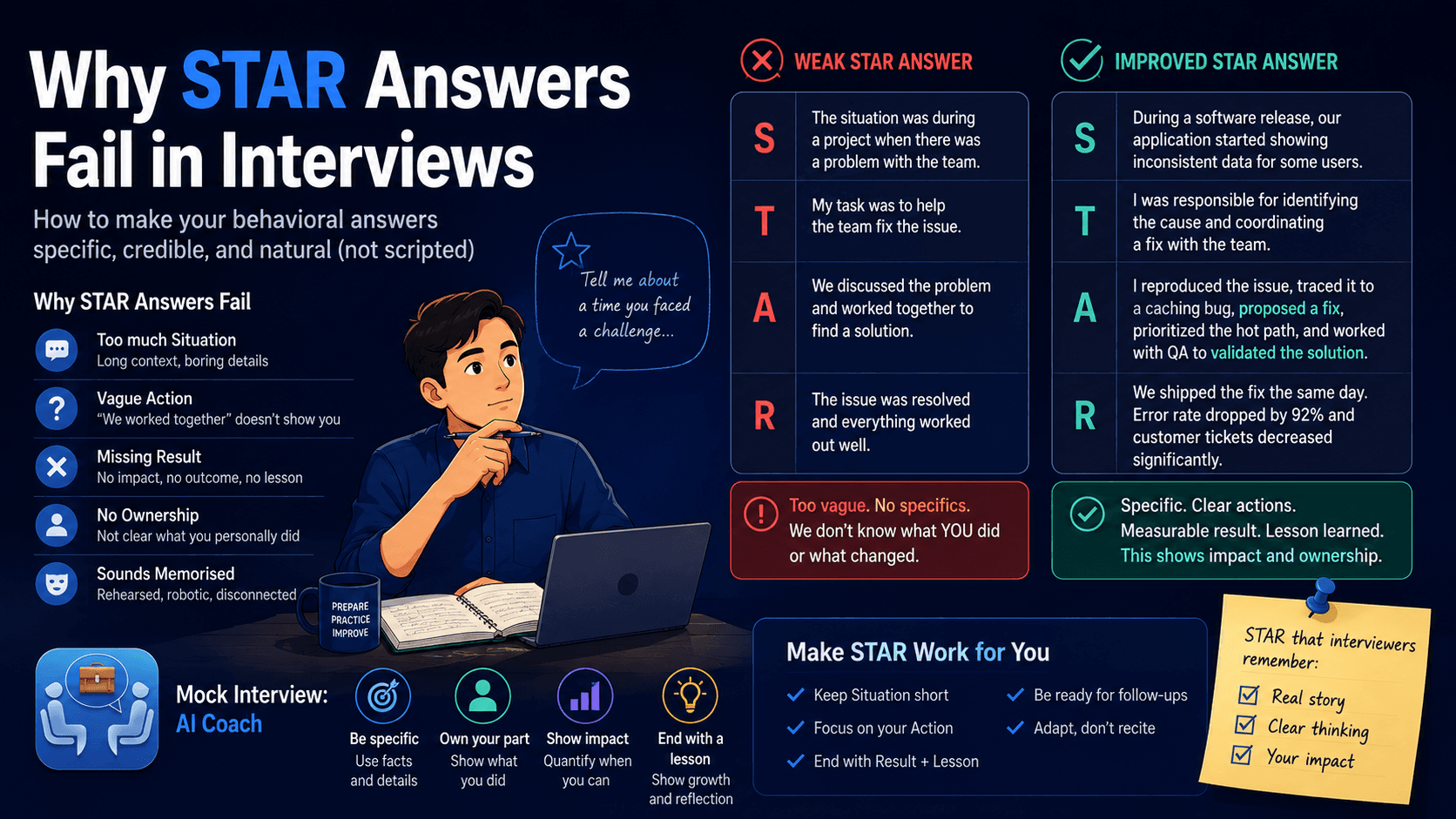
STAR is a simple structure for answering behavioral interview questions: Situation, Task, Action, and Result. The problem is not STAR itself — it is using the structure like a script instead of using it to make your own decisions, actions, and results clear.
1. Why a technically good STAR answer can still fail
A common STAR answer sounds organized on paper but falls apart when you say it aloud.
You explain what happened. You describe the task. You mention that "we worked together." Then you finish with something like, "Everything worked out well."
Technically, you covered STAR.
But the interviewer still does not know much about you.
The most common problems are:
- Too much time spent describing the situation
- Vague statements about what you actually did
- No clear result
- Little evidence of personal ownership
- A memorized delivery that sounds disconnected from the question
This matters across medical, engineering, and computer science interviews.
A medical candidate might describe a difficult team situation but never explain what they personally said or changed. An engineer might spend most of an answer describing a project instead of explaining the decision they made. A software candidate might describe a production problem but skip the specific debugging steps they took.
The fix is not to abandon STAR. It is to make each part do a specific job.
Think of it as a decision story, not a four-box template.
2. Keep the Situation short
The Situation should give the interviewer enough context to understand the problem. It does not need to tell the entire history of the project, rotation, placement, or job.
A useful test is simple:
Could the interviewer understand your problem after two or three sentences?
If yes, move on.
For example, imagine you are answering:
"Tell me about a conflict you had with a colleague."
A weak opening might spend a minute explaining the department, project history, everyone involved, and what happened before the conflict.
A stronger opening gets there quickly:
During a project, a colleague and I disagreed about how to handle a technical issue that was affecting the schedule. We had different views on which risk mattered most, and we needed to agree on an approach before the next project stage.
Now the interviewer has enough context.
Move to what you did.
The same applies to medical interviews. If you are describing a difficult interaction during training, you do not need to recreate every detail of the shift before explaining your role. And in computer science, if you are discussing a production incident, you can establish the impact and your responsibility without explaining the entire architecture first.
A good Situation answers one question:
Why did this situation require you to act?
Then stop.
3. Put the weight on Action
This is where most weak STAR answers lose their value.
Candidates often say:
We discussed the issue and came up with a solution.
Who is "we"?
What did you do?
What did you decide?
What did you say?
What changed because of your action?
Replace broad team language with specific behavior.
Instead of:
We worked together to solve the problem.
Try:
I reviewed the two options, identified the main risk with each one, and suggested that we compare them against the project requirement before deciding. I explained my concern to the team, asked for the other engineer's reasoning, and we agreed on the option that better fit the constraint.
Now the interviewer can see your behavior.
That is what makes an Action section credible.
Look for verbs that show what you actually did:
- Compared
- Investigated
- Asked
- Escalated
- Prioritized
- Documented
- Tested
- Explained
- Challenged
- Revised
- Coordinated
- Decided
- Followed up
Do not turn this into a list of impressive-sounding verbs. Every action should connect to the problem.
If you are preparing for an engineering interview, your Action might involve comparing designs, checking assumptions, communicating a risk, or changing a project plan. For a medical candidate, the Action might involve how you communicated with a colleague, responded to a difficult interaction, or reflected on feedback. For a computer science candidate, it might involve how you investigated a bug, changed an implementation, or coordinated a response to an incident.
The question to ask yourself is:
If I removed my name from this answer, would it still be obvious what I personally did?
If not, your Action section needs work.
4. Never let the Result disappear
A surprisingly common STAR mistake is ending immediately after the Action.
You explain what you did and then move to the next question.
The interviewer is left thinking: Did it work?
Your Result does not need to be dramatic. It needs to be concrete.
Weak:
The situation was resolved and the team was happy.
Better:
We agreed on the approach, completed the next stage without changing the requirement, and the disagreement did not delay the project.
Even better, add one short lesson:
The immediate result was that we agreed on the approach and kept the next stage on schedule. It also changed how I handle similar disagreements — I now try to establish the decision criteria before arguing for a solution.
That final sentence matters because it shows insight.
For a medical interview, the result might be an improved working relationship, clearer communication, or a change in how you approach similar situations. For engineering, it might be a project decision, reduced rework, or a clearer handover. For computer science, it might be resolving a technical issue, improving a process, or changing how you approach future incidents.
Do not invent impressive results.
If the outcome was mixed, say so.
A credible answer can include:
The immediate issue was resolved, but the original schedule still slipped. The experience taught me to raise that type of risk earlier.
That is more useful than pretending everything ended perfectly.
5. See what a weak STAR answer actually looks like
Consider this response to:
"Tell me about a time you made a mistake."
Weak answer:
During a project, I made a mistake with some of my work. I realized there was an issue, so I spoke to the team and we worked together to fix it. We were able to resolve everything and complete the project. It taught me that communication and attention to detail are important.
Nothing is obviously wrong with it.
It is simply too vague.
You do not know what the mistake was, what the candidate did, how serious it was, or what changed afterward.
Now compare it with this:
Improved answer:
During an engineering project, I underestimated the time needed for a testing stage and my original schedule left too little margin. I noticed the problem when the testing dependencies became clearer, so I raised it with the project lead rather than trying to make the original estimate work quietly. I helped revise the sequence and identified which tasks could continue while testing was underway. We completed the work with a revised schedule. Since then, I include testing dependencies earlier when estimating project timelines.
The second answer works because the interviewer can follow the chain:
Problem → personal action → outcome → lesson.
It also gives the interviewer several useful follow-ups.
They could ask why you underestimated the time, how you communicated the problem, or what you would do differently now.
That is a good sign. A strong behavioral answer should create a useful conversation, not end the conversation.
6. Stop memorising the exact wording
The more perfectly you memorize an answer, the more fragile it becomes.
Real interviews are interactive.
The interviewer might interrupt and ask:
- Why did you choose that approach?
- What would you do differently?
- What was your specific contribution?
A memorized STAR paragraph can suddenly become useless because you are trying to remember the next sentence instead of answering the new question.
Prepare story points, not scripts.
For each story, remember:
- The situation in two sentences
- Your responsibility
- Two or three important actions
- The result
- One lesson
Then let the wording change.
This also helps when the interviewer asks a slightly different question. One story about a team conflict might work for questions about disagreement, communication, leadership, or handling pressure — but you should emphasize the part that actually answers the question.
If you want to get better at staying clear when the conversation changes direction, practise explaining your thinking out loud.
7. Practise the five behavioral questions that matter most
You do not need twenty completely different stories.
Start with four or five strong experiences that can answer several question types.
Build stories around:
- Conflict: Tell me about a disagreement with a colleague or teammate.
- Failure: Tell me about a mistake or something that did not go as planned.
- Deadline pressure: Tell me about a time you had competing priorities.
- Teamwork: Tell me about a difficult team situation.
- Leadership: Tell me about a time you took responsibility or helped others move forward.
Your stories should come from your actual experience.
A computer science candidate might use a software project, debugging incident, code review disagreement, or production issue. An engineering candidate might use a design project, site problem, testing issue, safety concern, or coordination challenge. A medical candidate might use a training experience, team interaction, communication challenge, or situation that changed how they approach their work.
The story does not need to be spectacular. It needs to reveal how you behave when something requires judgment.
These are also the kinds of prompts that show up in common HR interview questions, so the same stories often transfer.
8. Make STAR flexible under pressure
The final test is whether you can use your story without sounding like you are reciting it.
Try answering the same story three ways:
- Give the full answer in about two minutes.
- Give the same answer in about one minute.
- Answer only the part the interviewer asks about.
Then add follow-ups.
Ask yourself:
- Why did you choose that action?
- What was your responsibility?
- What did the other person think?
- What would you change?
- What was the actual result?
- What did you learn?
This forces you to understand the story rather than memorize its wording.
It is also worth recording a few answers. Listen for long setup sections, repeated phrases, vague "we" statements, and endings that arrive without a clear result. You can practise interview answers alone if you need a simple way to build this into your routine. If you want structured prompts with feedback on clarity and specificity, Mock Interview: AI Coach lets you rehearse behavioral answers out loud on iPhone.
9. Use a simple practice routine
Take four or five real experiences and spend one session turning each into a flexible STAR story.
For every story, write only:
- Situation: 2–3 sentences
- Task: Your responsibility
- Action: 2–4 specific things you did
- Result: What changed
- Lesson: One sentence
Then practise each story aloud without reading the sentences.
On the next session, change the question.
Instead of asking, "Tell me about a conflict," ask:
"Tell me about a time you had to influence someone who disagreed with you."
Then use the same experience if it genuinely fits.
This is how you stop STAR from sounding mechanical.
The purpose of STAR is not to prove that you know four words. It is to make your behavior easy to understand.
Quick checklist before your interview
- Keep the Situation short and move quickly to what you personally did
- Replace vague "we" statements with specific actions, decisions, and conversations
- End every answer with a clear Result and one short lesson
- Prepare four or five real stories that can flex across conflict, failure, deadlines, teamwork, and leadership questions
- Practise follow-ups so you can answer naturally without returning to a memorized script
- Say your answers out loud and listen for rambling, missing ownership, vague actions, and weak endings
A strong STAR answer should sound like you are explaining something that actually happened, not performing a template. Keep the structure underneath, but let the conversation determine the wording.
Practise those answers before the real interview with Mock Interview: AI Coach on the App Store.
Ready to practice for real?
Try Mock Interview Training free on iPhone — voice or text practice, optional CV upload, and saved reviews.
Download app