
September 3, 2026 · Mock Interview Training Team
How to prepare for an engineering interview
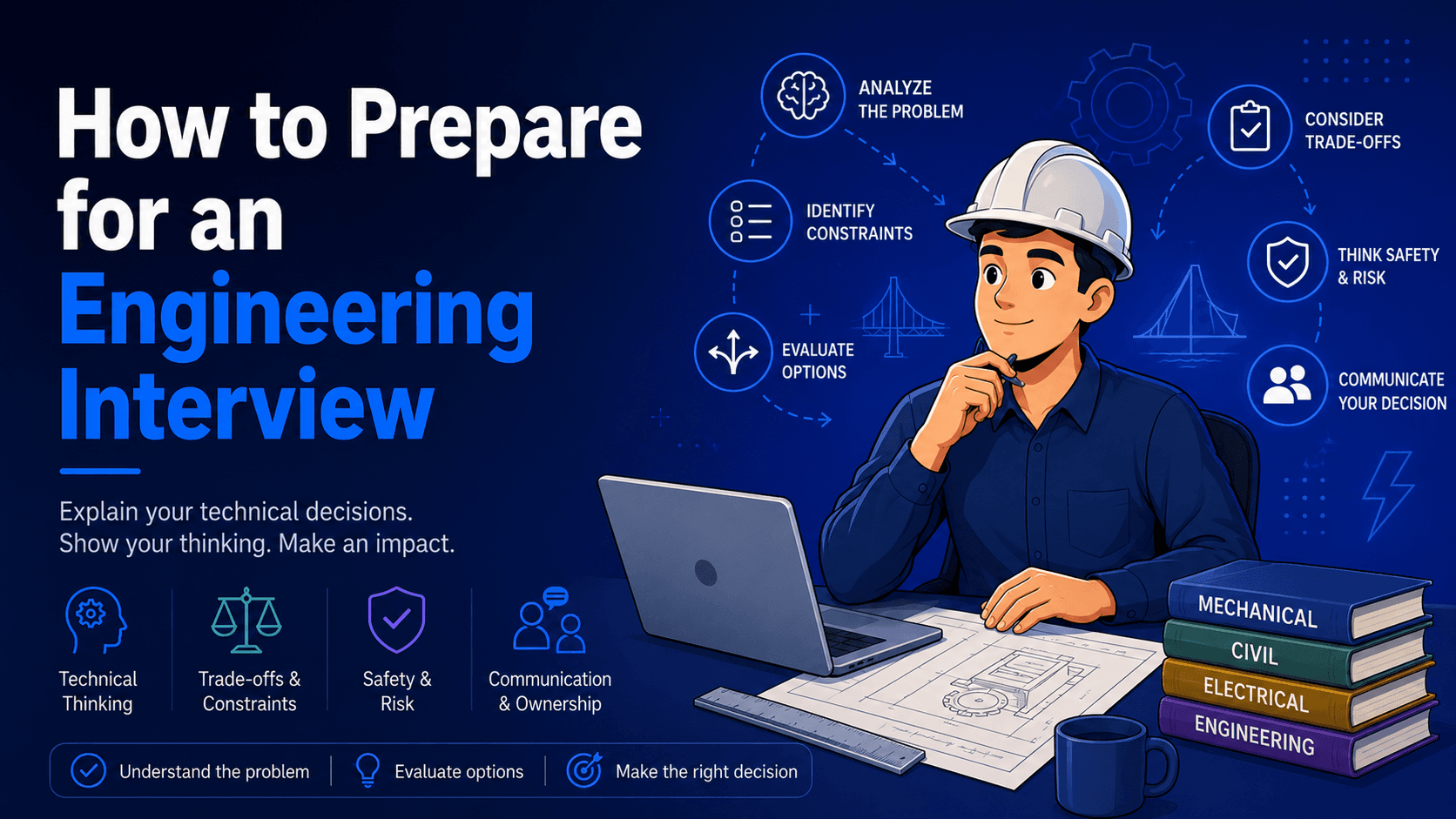
The best way to prepare for an engineering interview is to practice explaining why you made a technical decision, not just memorizing the theory behind it. You need to show that you can understand constraints, compare options, communicate risk, and take ownership when a design or project does not go as planned.
1. Know what engineering interviews actually assess
Engineering interviews often include technical questions, but the interviewer is rarely interested only in whether you can remember a formula from university.
They want to understand how you use engineering knowledge when the problem is not neatly written in an exam question.
Your interviewer may be assessing:
- Decision-making: Can you choose between realistic alternatives and explain why?
- Safety awareness: Do you recognize hazards, failure modes, and consequences?
- Trade-offs: Can you explain what you gain and give up with a particular design?
- Communication: Can another engineer understand your reasoning?
- Ownership: Can you explain what you personally did, including mistakes and limitations?
- Practical judgment: Can you connect theory to materials, equipment, manufacturing, construction, testing, or operation?
This changes how you should prepare.
Suppose you are asked why you selected a particular material. A weak answer might list its properties from a textbook. A stronger answer explains what the project required, which properties mattered, what alternatives you considered, and why the final choice made sense.
The same principle applies across disciplines.
A civil engineering interviewer may ask why you approached a structural or site problem in a particular way. A mechanical interviewer may ask why you selected one component or manufacturing approach over another. An electrical interviewer may ask how you would evaluate competing design requirements.
The technical knowledge is still important. But you need to make your reasoning visible.
If this is something you struggle with, learn how to explain your thinking out loud in an interview before you start building your practice routine.
2. Explain every project with a clear engineering story
Your projects are one of the best ways for an interviewer to understand how you actually work.
Do not prepare by memorizing a long project description. Prepare the engineering story behind it.
Use this sequence:
- Problem: What needed to be solved?
- Constraints: What limited the possible solutions?
- Options: What approaches did you consider?
- Decision: What did you choose and why?
- Result: What happened after the decision?
- Reflection: What would you change now?
For example, imagine you worked on a mechanical component where reducing weight was important.
A weak answer would be:
"We changed the material to reduce the weight of the component."
A stronger answer would sound more like:
"The main objective was to reduce the component's weight without compromising the performance requirements. We considered several material and geometry options, but each introduced a different trade-off between weight, stiffness, manufacturing complexity, and cost. We selected the option that best matched the project's constraints. Looking back, I would spend more time evaluating the manufacturing implications earlier because that became an important consideration later."
Notice what changed. The second answer gives the interviewer something to evaluate. They can ask why the material mattered, how you compared the options, or what manufacturing issue appeared.
You should be able to tell the same story about a civil, mechanical, or electrical project.
For example, a civil engineering project might involve choosing between construction approaches while balancing site conditions, schedule, cost, and safety. An electrical project might involve selecting a system architecture while considering performance, reliability, installation requirements, and maintainability.
Your job is not to make the project sound complicated. Your job is to make the decision understandable.
3. Handle technical depth without freezing
Technical interviews often become difficult when the interviewer starts asking follow-up questions.
You explain your design and then hear:
"Why did you choose that?"
You answer.
Then:
"What would happen if that constraint changed?"
Then:
"What would you calculate to verify it?"
If you try to predict every possible follow-up, you will overload yourself.
Instead, answer in layers.
Start with the high-level engineering reason. Then add the technical detail that directly supports it. If the interviewer wants more depth, go deeper.
For example:
"I chose this approach because it met the main performance requirement while keeping the design relatively simple."
If they ask for more:
"The main technical consideration was stiffness rather than just strength, so I compared the options against that requirement."
If they go deeper again, then discuss the relevant calculations, assumptions, testing, or analysis you actually used.
This approach prevents you from jumping into equations before you have established what problem you are solving.
It also gives the interviewer a natural way to assess your depth. You do not need to demonstrate everything you know in your first sentence.
A useful rule is: explain the engineering decision first, then support it with technical detail.
You can use the same approach for common technical questions such as:
- How would you select a material for this application?
- What factors would you consider when designing this component?
- How would you investigate a system failure?
- What would you check before approving a design?
- How would you improve the reliability of this system?
- What assumptions are you making?
- What changes if the main constraint becomes cost, weight, temperature, or schedule?
If you want more technical-interview-specific preparation, see how to prepare for a technical interview.
4. Talk about safety, standards, and risk carefully
Safety questions are an opportunity to show engineering judgment, but they are also an easy place to overstate your knowledge.
Do not invent a code requirement because you think the interviewer expects you to know one.
If you know the applicable standard or requirement, explain how you used it. If you do not remember the exact reference, be honest about that and explain the process you would follow to verify it.
For example:
"I would first identify the applicable standard and project requirements, then verify the design against them rather than relying on memory for a specific clause."
That is stronger than confidently naming a standard that may not apply.
When discussing risk, explain the sequence you would follow:
- Identify the hazard or failure mode.
- Consider who or what could be affected.
- Estimate the significance of the risk using the process appropriate to the project.
- Consider ways to eliminate or reduce the risk.
- Verify that the chosen controls are actually suitable.
- Escalate issues when they exceed your responsibility or expertise.
You can also explain what information you would need before making a decision.
For example, if asked about a design with an uncertain loading condition, you could say:
"I would not assume the missing load. I would first confirm the design basis and applicable requirements, then assess the available options against that information."
That shows caution without pretending to have knowledge you do not have.
5. Prepare for behavioral questions like an engineer
Engineering interviews are not only technical.
You may be asked about a disagreement with another engineer, pressure from a deadline, a mistake, mentoring a junior colleague, or handing work over to someone else.
Prepare specific examples for:
- A conflict on a project or site.
- A deadline that created competing priorities.
- A technical mistake or incorrect assumption.
- A time you received difficult feedback.
- A time you helped someone understand a technical problem.
- A handover where clear documentation or communication mattered.
Avoid turning these into polished success stories where everything worked perfectly.
A good mistake answer should explain:
What happened → what you did → what you learned → what you changed afterward.
For example:
"I initially underestimated how much time the testing stage would require. Once I realized the schedule was at risk, I raised it with the team rather than trying to hide the problem. We adjusted the plan, and afterward I started accounting for testing dependencies earlier when estimating project timelines."
That demonstrates ownership without claiming that you never make mistakes.
The same principle applies to conflict. Do not make the other person the villain. Explain what you disagreed about, how you approached the conversation, what evidence mattered, and what happened afterward.
For broader interview questions, learn how to answer "Tell me about yourself" in an interview and adapt the structure to your engineering background.
6. Avoid the habits that weaken technical answers
Several mistakes repeatedly make technically capable candidates sound less prepared than they are.
Jumping straight into equations. Before calculating anything, explain what you are trying to determine and which assumptions matter.
Giving only one option. Even if you have a preferred solution, briefly explain what alternative you considered and why you rejected it.
Ignoring constraints. A technically elegant design may be unsuitable because of cost, manufacturability, installation, maintenance, schedule, available equipment, or safety requirements.
Going silent while thinking. A short pause is fine. If you need more time, explain what you are considering:
"I'm comparing two approaches here. The main trade-off is between simplicity and performance."
Now the interviewer can follow your reasoning instead of guessing whether you are stuck.
Claiming ownership of work you did not do. Be precise about your contribution. Say "I analyzed the load case" if that was your responsibility rather than implying that you designed an entire system yourself.
Memorizing scripts. Prepare your project facts and decision points, but do not memorize every sentence. Follow-up questions rarely arrive in exactly the order you rehearsed.
The goal is to become comfortable explaining technical decisions even when the interviewer changes the question.
7. Use a realistic 7–14 day practice routine
Your final preparation should include speaking, not just reading.
During the first few days, build a question set from your actual background:
- Explain your most important engineering project.
- Why did you choose that design?
- What alternatives did you reject?
- What was the biggest constraint?
- Tell me about a technical mistake.
- Tell me about a conflict on a team or site.
- How did you handle a difficult deadline?
- How do you approach safety and risk?
- What would you change about one of your projects?
- Explain a technical concept to someone without an engineering background.
Then practice answering aloud with a timer.
Mock Interview: AI Coach can help you practise technical answers out loud and get feedback on how clearly you explain your reasoning.
A simple two-week schedule looks like this:
- Days 14–10: Review your projects, identify your technical decisions, and write down the constraints and alternatives for each.
- Days 9–7: Practice project explanations and technical questions aloud without a script.
- Days 6–4: Add behavioral questions, safety scenarios, and technical follow-ups.
- Days 3–2: Use timed mixed interview sessions and deliberately practice recovering when you do not immediately know the answer.
- Day 1: Review your key projects, achievements, mistakes, and technical decision points. Avoid trying to memorize new answers.
If you only have seven days, combine the first two stages and spend the remaining days on timed answers and follow-up questions.
After each practice session, ask yourself three things: Did I answer the actual question? Did I explain why I made the decision? Did I make the important constraints and trade-offs clear?
That review is more useful than simply counting how many questions you completed.
Quick checklist before your interview
- Can you explain your three strongest projects using problem, constraints, options, decision, result, and reflection?
- Can you explain a technical decision without immediately jumping into equations?
- Can you name at least one alternative for your major design decisions and explain why you rejected it?
- Can you discuss safety, standards, and risk without inventing requirements you do not know?
- Do you have specific examples of a mistake, conflict, deadline problem, and mentoring or handover situation?
- Have you answered technical questions out loud under time pressure, rather than only rehearsing them mentally?
Mock Interview: AI Coach can help you practise engineering interview answers out loud and get feedback before the interview.
Ready to practice for real?
Try Mock Interview Training free on iPhone — voice or text practice, optional CV upload, and saved reviews.
Download app