
August 31, 2026 · Mock Interview Training Team
How to prepare for a residency or medical school interview
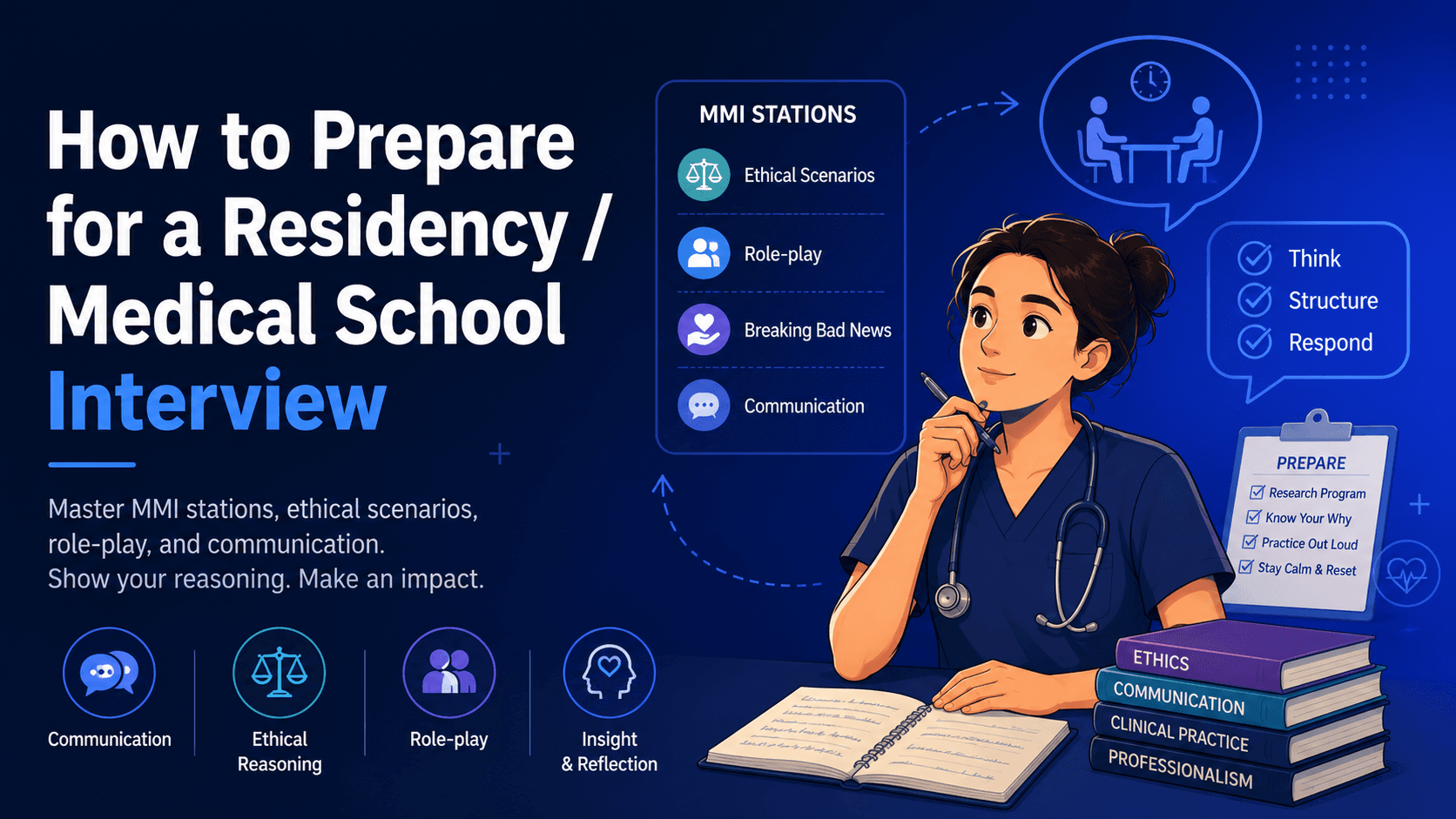
The most useful way to prepare for a residency or medical school interview is to practice explaining your reasoning out loud under time pressure, especially for ethical and MMI scenarios. Your academic record shows what you have learned; the interview gives you a chance to show how you communicate, reflect, handle uncertainty, and work through difficult situations.
1. Understand what the interview is really assessing
A common mistake is preparing for a medical interview like another academic exam. You revise clinical facts, memorize definitions, and worry about being asked something you cannot recall.
That can leave you underprepared for what the interview actually reveals about you.
Residency and medical school interviews can assess how clearly you communicate, how you approach difficult situations, how you work with other people, and whether you can reflect on your own experiences. In an MMI, the scenario may deliberately give you no obvious factual answer. The point is often to see how you reason through the situation.
Focus your preparation on four areas:
- Communication: Can you make your point clearly without becoming vague or overly long?
- Ethical reasoning: Can you recognize competing interests and explain how you would approach them?
- Professionalism: Can you remain respectful and responsible when a situation becomes uncomfortable?
- Insight: Can you discuss your mistakes, decisions, limitations, and experiences honestly?
This is different from what many candidates assume. You are not primarily trying to prove that you can remember the most clinical facts in the room.
Clinical knowledge still matters where it is relevant to the interview, but knowing an answer is not the same as demonstrating judgment. If an interviewer asks you to discuss an ethical situation, reciting medical terminology will not replace explaining how you reached your conclusion.
The same principle applies to traditional questions. Your answer to "Tell me about yourself" should show more than a list of achievements. Learn how to answer "Tell me about yourself" in an interview with a structure that connects your experiences to where you are going.
2. Learn how the MMI format changes your preparation
An MMI, or Multiple Mini Interview, is built around several short interview stations rather than one continuous conversation.
The exact format varies between institutions, but a typical station gives you a prompt to read before entering the room. You may have a limited amount of preparation time, followed by a timed interaction with an interviewer or another participant.
A station might ask you to:
- Discuss an ethical scenario.
- Explain how you would handle a conflict.
- Respond to a communication problem.
- Take part in a role-play.
- Explain your reasoning about a difficult situation.
- Discuss a decision where more than one perspective is reasonable.
A major difference from a traditional interview is that stations are generally assessed independently. Your performance at one station does not automatically determine how you perform at the next.
That matters because candidates often make one bad station worse by carrying it into the next.
You stumble through a role-play. You leave the room thinking, "That was terrible." Then you spend the next preparation period replaying what you should have said. You enter the next station distracted.
Instead, treat every station as a reset:
- Read the prompt carefully.
- Identify what the scenario is testing.
- Choose a simple structure.
- Enter and communicate your reasoning.
- Leave the station behind when it ends.
You do not need a completely different personality for each station. You need a repeatable process for dealing with unfamiliar questions.
3. Use a four-part structure for ethical scenarios
Ethical MMI questions can make you anxious because you may feel there must be one perfect answer.
Usually, the stronger approach is to show how you think about the competing considerations.
Consider a scenario where a colleague tells you they made an error affecting a patient and asks you not to tell anyone because they are afraid of the consequences.
A thin answer might be:
"I would report it because patient safety is important."
That gives a conclusion but very little reasoning.
Instead, work through four steps.
First, identify the stakeholders. Consider who could be affected by the situation. Depending on the scenario, this could include the patient, the colleague, other members of the team, and the wider organization.
Second, name the competing principles. Explain what values are in tension. You might discuss responsibility, honesty, fairness, confidentiality, professional accountability, and concern for the people involved.
Third, propose an action. Explain what you would do and why. Keep your answer grounded in the scenario rather than presenting yourself as someone who can personally solve every part of a complex situation.
Fourth, acknowledge the trade-off. Show that you understand why the decision is difficult. A strong answer can recognize the colleague's concerns without ignoring the other responsibilities involved.
You can apply the same structure to MMI questions such as:
- A colleague disagrees with a decision you made. How would you handle it?
- A patient becomes upset during a difficult conversation. What would you do?
- You notice behavior from a classmate that concerns you. How would you respond?
- You are asked to make a decision when two people have competing needs.
- You disagree with someone who has more experience than you. How would you approach the disagreement?
The goal is not to memorize a universal ethical answer. It is to show that you can identify the people affected, recognize competing principles, make a considered choice, and explain the consequences of that choice.
4. Prepare specifically for role-play and communication stations
Role-play is uncomfortable because you cannot prepare a factual answer and deliver it from memory. You have to listen and respond to another person.
That is exactly why you should practice it.
A breaking-bad-news station, for example, is less about delivering an impressive speech and more about how you communicate when the other person is upset. Similarly, if you are asked to handle an upset colleague or patient, immediately defending yourself can make the interaction feel unnatural.
Start by listening.
A useful sequence is:
- Let the other person explain their concern.
- Acknowledge what they are experiencing without automatically agreeing with every claim.
- Ask a focused question if you need more information.
- Explain your position clearly.
- Avoid unnecessary jargon.
- Check that the person has understood you.
- Stay calm if they disagree or remain upset.
For example, imagine an upset colleague says that you undermined them in front of the team.
A defensive response might be:
"That was not my intention. I was only trying to help."
A more useful opening would be:
"I can see why that came across that way. I'd like to understand what happened from your perspective before I explain what I intended."
You have not admitted to something you did not establish. You have simply created room for the conversation to move forward.
Do the same with patient communication scenarios. Do not try to sound impressive. Try to sound clear, respectful, and attentive.
This is also where explaining your thinking out loud in an interview becomes useful. You want the interviewer to hear your reasoning instead of watching you disappear into silence while you decide what to say.
5. Build specific answers for motivation and programme fit
"Why this specialty?" and "Why this programme?" are questions where generic preparation causes problems.
"I want to help people, and this programme has an excellent reputation" could be used almost anywhere. It tells the interviewer very little about you.
For why this specialty, prepare specific evidence from your own experience:
- What first interested you in the specialty?
- Which experiences confirmed or challenged that interest?
- What aspects of the work hold your attention?
- What skills or responsibilities do you want to develop?
For why this programme, research the individual programme rather than memorizing a generic answer. Identify features that genuinely matter to your goals, then explain the connection.
For example, instead of saying:
"I like this programme because it offers excellent training."
Say what you actually found compelling:
"During my research into the programme, I was particularly interested in its emphasis on X. That connects with my experience in Y and the area I want to develop during residency."
The specific details need to come from your own research. Do not invent a connection simply because it sounds good.
Your answer should also survive a follow-up question. If the interviewer asks, "Why does that matter to you?" you should have a real experience behind your answer.
6. Avoid the mistakes that make good candidates look unprepared
Several interview habits can weaken an otherwise strong answer.
Rushing to a verdict. You hear an ethical scenario and immediately announce what you would do. Take a moment to identify the competing considerations first.
Giving only one side. Saying "patient safety comes first" or "I would always support my colleague" without acknowledging the other concerns makes your reasoning look incomplete.
Memorizing scripts. Scripts can help you organize your preparation, but memorized paragraphs often fall apart when the question changes slightly. Prepare ideas and examples rather than exact sentences.
Going silent while thinking. A short pause is fine. A long silence gives the interviewer no information about what you are considering. State your approach: "I'd like to think about the people affected first," or "There are two factors I'd want to weigh here."
Over-answering. More words do not automatically mean more insight. Answer the question, explain the important reasoning, and stop when you have made the point.
If you tend to practice only in your head, change that habit before interview day. Practice interviews alone without a friend by speaking your answers aloud and reviewing whether your reasoning is actually clear when spoken.
For the final two weeks, make the practice progressively more realistic. In the first few days, build your question list and identify the experiences you want to use. Then introduce timed answers. In the final week, simulate short MMI stations with limited preparation time and move immediately from one scenario to the next.
A useful routine is:
- Days 14–10: Prepare your core experiences, motivation answers, and ethical scenario structures.
- Days 9–6: Answer questions aloud and identify recurring problems such as rushing or rambling.
- Days 5–3: Add timed MMI stations and role-play scenarios.
- Days 2–1: Run shorter mixed sessions and review your key examples rather than learning new scripts.
For timed practice, Mock Interview: AI Coach lets you practise answers out loud and get feedback while you work on your delivery and reasoning.
The purpose of this routine is not to make every answer perfect. It is to make speaking through an unfamiliar problem feel normal.
Quick checklist before your interview
- Can you explain why medicine, why your specialty, and why this programme using specific experiences rather than generic statements?
- Can you structure an ethical scenario around stakeholders, competing principles, action, and trade-offs?
- Have you practiced role-play situations involving an upset patient, colleague, or difficult conversation?
- Can you answer under a timer without rushing to a verdict or going completely silent?
- If you make a mistake in one MMI station, can you reset before the next one?
- Have you practiced enough answers out loud that you are not relying on mental rehearsal alone?
Mock Interview: AI Coach can be used to practise answers out loud and get feedback before interview day.
Ready to practice for real?
Try Mock Interview Training free on iPhone — voice or text practice, optional CV upload, and saved reviews.
Download app