
September 5, 2026 · Mock Interview Training Team
How to answer CV-based interview questions
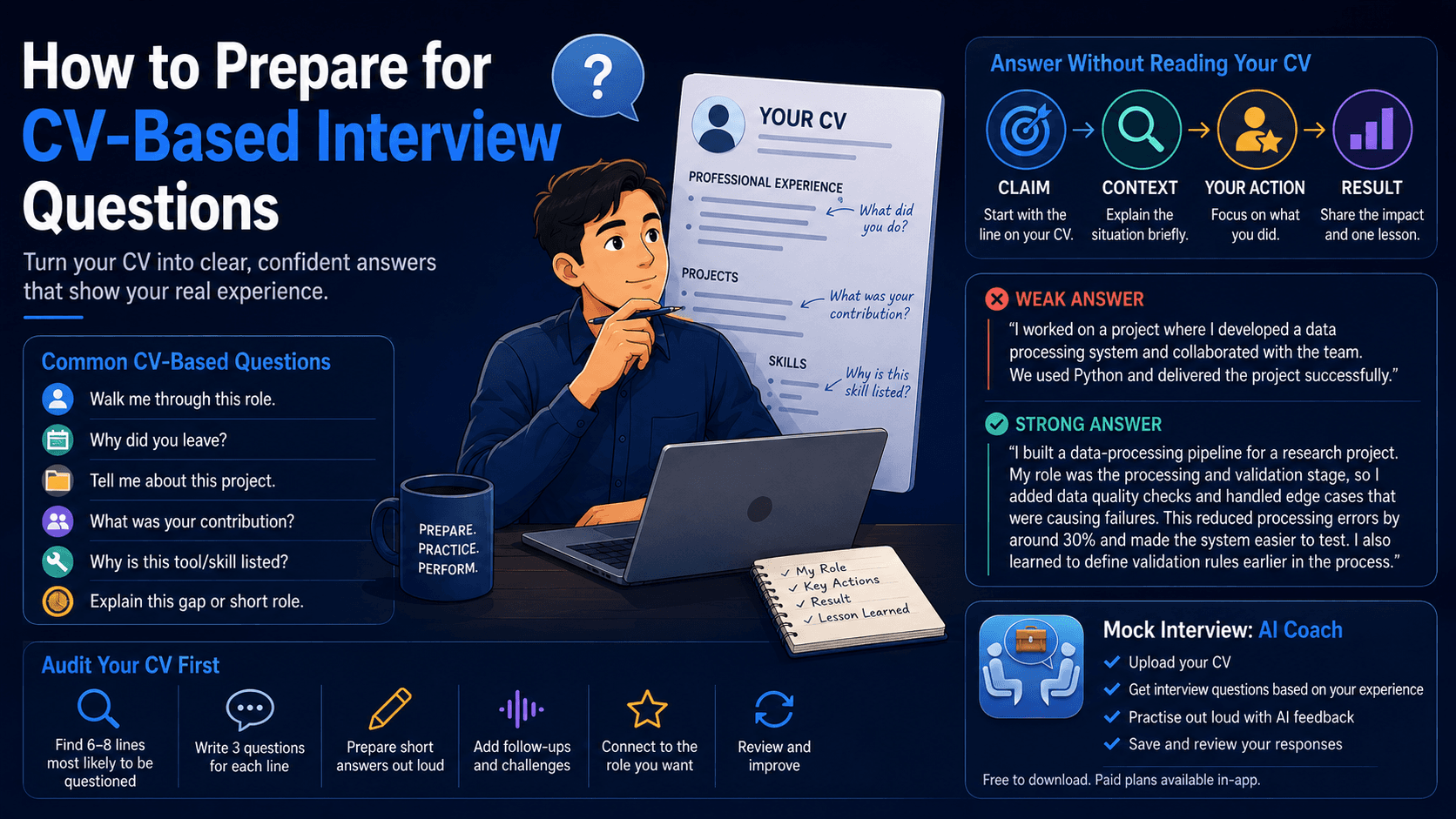
Your CV is not just a document an interviewer reads before the interview — it is a list of claims they can test. The best preparation is to turn the important lines on your CV into short, flexible stories that explain what you did, why it mattered, and what you learned.
1. Treat every line on your CV as a question
When an interviewer sees a job title, project, technical skill, clinical experience, or achievement on your CV, they have a reason to ask about it.
That does not mean they will ask about every line. It means you should be able to defend the important ones without reading the document back to them.
For example, if your CV says:
Developed a machine learning model for image classification.
The interviewer can reasonably ask:
- What problem were you solving?
- What was your contribution?
- Why did you choose that approach?
- What tools did you use?
- What went wrong?
- How did you evaluate the result?
An engineering CV creates similar questions:
Designed an electrical distribution system for a commercial project.
You may be asked what you actually designed, what constraints you faced, which alternatives you considered, and how the final decision was made.
A medical CV might mention a clinical placement, research project, audit, or leadership role. You should expect questions about your specific responsibility, what you learned, and how the experience influenced your approach.
The mistake is preparing for the job description while ignoring your own CV.
Before the interview, your CV should be one of your main question banks.
2. Audit your CV before the interview
Take your actual CV and mark the six to eight lines most likely to be challenged.
Look for lines that contain:
- A strong achievement
- A technical skill or tool
- A project with measurable claims
- A short job or placement
- A recent career change
- A gap in employment or education
- A leadership or responsibility claim
- Something that sounds more senior than your other experience
For each one, write three questions.
Question 1: What did you actually do?
This exposes inflated or vague wording.
Question 2: How did you do it?
This exposes whether you have enough technical or practical depth behind the claim.
Question 3: What changed because of it?
This forces you to explain the result rather than simply describing activity.
For example, if your CV says you "improved a testing process," you should know what the old process looked like, what you changed, why you changed it, and what happened afterward.
Do this before opening a generic list of interview questions. Your CV is more relevant to you than someone else's question bank.
3. Answer the CV instead of reading it aloud
One of the most common CV-based interview mistakes is repeating the bullet point.
Interviewer:
Tell me about this project.
Candidate:
I worked on a software project where I developed a data processing system and collaborated with the team.
That is almost the same information already printed on the page.
Instead, use this structure:
Claim → context → your action → result.
Start with the claim from the CV, then add the information the interviewer cannot see.
For example:
The project involved building a data-processing pipeline for a research application. My responsibility was the processing and validation stage, so I first mapped where unreliable inputs were entering the system. I changed the validation process and added checks around the highest-risk inputs. That made the workflow easier to test and gave the team a clearer way to identify bad data.
Notice what is missing: a long introduction to the project.
The interviewer already has the CV.
Your job is to add the story behind it.
This structure works across fields. An engineer can explain the constraints behind a design decision. A medical candidate can explain their responsibility in a project or placement. A computer science candidate can explain why they chose a particular technical approach.
If the story involves a significant challenge, the STAR method can help you structure the action and result without making the answer sound scripted.
4. Prepare for the questions hiding inside your CV
Some CV questions appear repeatedly because they test areas where candidates often become defensive or vague.
"Walk me through this role."
Do not repeat your job description.
Explain:
- What the role involved
- What you personally owned
- One important problem you handled
- What the experience taught you
This is also a natural place to tighten your Tell me about yourself answer so it connects to the roles on the page.
"Why did you leave?"
Keep the answer factual and professional.
Do not use the question to criticize a previous employer, supervisor, team, university, or department. Explain what changed and what you were looking for next.
"Tell me about this project."
Give the purpose, your contribution, one meaningful decision, and the result.
"What was your contribution?"
Be precise about ownership.
If the project was a team effort, say what the team did and then identify your part. Do not turn "we" into "I" just to make the story sound stronger.
"Explain this gap."
You do not need an elaborate defense.
Give a concise explanation, explain what you were doing during the period if relevant, and move toward what you are doing now.
"Why is this tool or skill listed?"
This is where unsupported CV claims get exposed.
If you list Python, CAD software, MATLAB, a clinical system, laboratory technique, cloud platform, or another tool, know what you actually used it for.
Do not claim expert-level knowledge when your experience was limited.
A credible answer is:
I used it for a university project and have practical experience with the parts needed for that work. I would not describe myself as advanced yet.
That is much safer than trying to bluff through a technical follow-up.
5. Fix ownership problems before they become follow-ups
Your CV may use strong language because you wanted to make your experience sound professional.
The interview gives the interviewer a chance to test whether the wording matches reality.
Watch for three problems.
"We" language.
"We developed the system" does not tell the interviewer what you did.
Use "we" for team outcomes and "I" for your own contribution.
Inflated titles or responsibilities.
If your formal role was junior but you coordinated one part of a project, describe that accurately. Do not imply you managed an entire project if you did not.
Tools with no depth.
A long skills section creates more questions. If you list a tool, be ready to explain where you used it, what you did with it, and what you still need to learn.
A useful test is:
Could I explain this line to someone who knows the field well?
If the answer is no, either prepare properly or change the wording.
For engineering candidates, your project descriptions should make your decisions and constraints clear. See how to prepare for an engineering interview for a deeper approach to technical project questions.
For medical candidates, the same principle applies to placements, research, audits, volunteering, and leadership experiences. Your CV should lead to a real conversation about your experience, not a recital of activities. Residency and medical school interview prep covers how to turn that experience into clear spoken answers.
6. Handle weak spots without becoming defensive
Not every CV has a perfect progression.
You may have a short role, an unfinished project, a career change, a gap, or an experience that did not work out.
Do not try to make the weak spot disappear.
Explain it briefly, take ownership where appropriate, and focus on what you learned or what changed afterward.
For an unfinished project:
The project did not reach the original completion point because the scope changed. My part was completed through the initial testing stage, and the experience taught me to clarify scope and dependencies earlier.
For a short role:
The role was shorter than I expected, but it gave me exposure to X and helped me clarify that I wanted to develop further in Y.
For a career change:
My earlier experience gave me a foundation in X, but through that work I became more interested in Y. I then deliberately built experience in Y through these projects and roles.
Do not invent a lesson simply because interviews are supposed to have lessons.
If the experience was genuinely difficult, you can say that. The goal is to demonstrate that you understand your own career decisions.
7. Connect your CV to the role without forcing it
A strong CV answer eventually helps the interviewer understand why your experience is relevant to the role you want.
But do not force every story into a sales pitch.
Suppose you are interviewing for a software role and your CV includes a university research project.
You could explain:
The project gave me experience working with messy data and debugging an unfamiliar codebase. That is the part of the experience I think is most relevant here.
That is enough.
For an engineering role, connect a project to the type of decisions the position requires.
For a medical role, connect relevant experiences to the skills or responsibilities you are discussing without pretending one experience makes you qualified for everything.
The connection should feel like an explanation, not a slogan.
8. Practise from your CV, not from a generic question list
Start with your CV open in front of you.
Choose five lines and answer these questions aloud for each:
- What did I actually do?
- What was my responsibility?
- What was difficult?
- What decision did I make?
- What was the result?
- What would I do differently now?
Then ask follow-ups that deliberately challenge your wording.
If your CV says you "led" something, ask:
What did leadership look like in practice?
If it says you "improved" something:
How did you know it was better?
If it says you "used" a tool:
What did you use it for, and what limitations did you encounter?
Practising with your own CV makes the session more realistic because the questions start from evidence an interviewer can actually see.
Mock Interview: AI Coach lets you upload your CV so you can practise answers out loud based on your real experience and get feedback on those answers.
You can also practise interview answers alone by recording yourself and checking whether your answers add useful information beyond what is already written on the page.
9. Use a short routine in the final week
You do not need to memorize every possible question.
Instead, spend several short sessions working through your CV.
- Session 1: Mark six to eight high-risk CV lines.
- Session 2: Build a short spoken answer for each line using claim, context, action, and result.
- Session 3: Add follow-ups about ownership, technical depth, mistakes, and decisions.
- Session 4: Practise the weak spots — gaps, short roles, career changes, unfinished work, and skills where your experience is limited.
- Session 5: Run a mixed session where you do not know which CV line will be questioned next.
Keep the answers flexible. An interviewer may interrupt after twenty seconds because they want to explore one detail. That is normal.
The goal is not to finish your prepared answer.
The goal is to understand your experience well enough that you can talk about it from different angles.
Quick checklist before your interview
- Mark six to eight CV lines that are most likely to generate follow-up questions
- Know exactly what you personally did for every important project, role, and achievement
- Prepare short answers for why you left, career changes, gaps, short roles, and unfinished projects
- For every listed skill or tool, know where you used it and how much practical depth you actually have
- Practise explaining each major claim using context → action → result, without repeating the CV bullet
- Answer follow-up questions out loud so you can stay flexible when the interviewer interrupts or asks for more detail
Your CV gets you into the conversation; your explanation gives the interviewer evidence behind it. Prepare the document line by line, and you will spend less time trying to remember what you wrote and more time explaining what you actually did.
Practise those CV-based answers with Mock Interview: AI Coach on the App Store.
Ready to practice for real?
Try Mock Interview Training free on iPhone — voice or text practice, optional CV upload, and saved reviews.
Download app