
September 6, 2026 · Mock Interview Training Team
Why Practicing Interview Answers in Your Head Doesn't Work
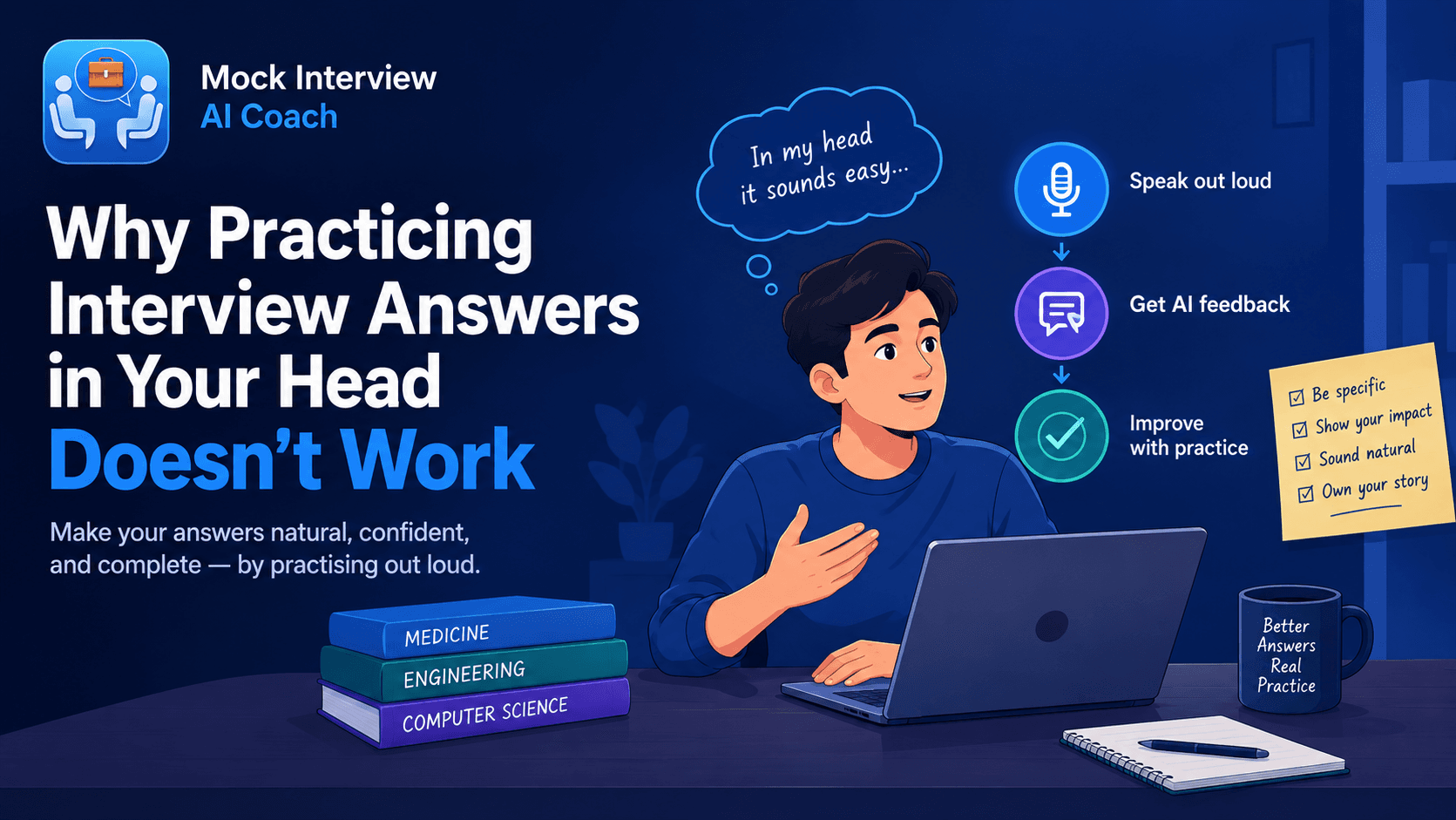
Silent interview practice feels productive because you can think through an answer quickly and convince yourself that you know what to say. The problem is that a real interview does not happen in your head — you have to think, organise your answer, and speak at the same time.
The best way to prepare is to practise your answers out loud before the interview. You do not need to memorise scripts or spend hours talking to yourself. You need to make spoken thinking part of your preparation.
This matters whether you are preparing for a medical interview, an engineering role, or a computer science position. The questions may be different, but the problem is often the same: you understand the answer internally, then struggle to explain it clearly when someone is waiting for you to speak.
Why mental rehearsal is not enough
Thinking about an answer and saying it out loud are different skills.
In your head, your thoughts move quickly. You can skip steps without noticing because you already understand the context. You know what you meant when you thought about a project, a clinical experience, or a technical decision.
An interviewer does not have access to that context.
When you answer aloud, you have to decide:
- Where to start
- What information matters
- What to leave out
- How to explain your reasoning
- When to stop
That is where many candidates discover that an answer they thought they knew is actually incomplete.
For example, you may think:
"I know exactly why we chose that approach."
But when asked to explain it, your answer becomes:
"We looked at a few options and decided this was the best one because it worked better for the project."
You know more than you just said. The problem is turning that knowledge into a clear explanation under pressure.
Silent preparation also hides other problems.
You may freeze when you have to start speaking
In your head, there is no awkward first sentence. You simply begin thinking.
In an interview, you need to start somewhere. Candidates often know the answer but lose momentum trying to find the perfect opening.
Practising aloud teaches you how to begin without waiting for perfect wording.
You may ramble without noticing
Mental answers are usually shorter than spoken answers.
When you speak, you may repeat yourself, add unnecessary background, or go into technical detail before explaining the main point.
Recording yourself once or twice can make this obvious very quickly.
You may know the facts but struggle to explain your thinking
This is especially common in technical and medical interviews.
You may know the diagnosis you are considering, the engineering principle involved, or how an algorithm works. But interviewers often want to understand how you reached your conclusion.
That is why explaining your thinking out loud is worth practising as a separate skill.
What good out-loud practice actually looks like
Practising aloud does not mean memorising a perfect answer and repeating it until it sounds artificial.
The goal is to become comfortable building an answer in real time.
A useful practice session is short and focused.
1. Answer a real question fully
Do not stop after the first sentence because you think you know where the answer is going.
Ask yourself the question and answer it as if someone were actually interviewing you.
For example:
- "Tell me about a difficult case or clinical experience."
- "Walk me through a design decision you made."
- "Tell me about a technical problem you solved."
- "Why did you choose this specialty or field?"
- "Describe a mistake and what you changed afterward."
Finish the answer before judging it.
2. Record yourself occasionally
You do not need to record every practice session.
Record enough to notice patterns.
Listen for:
- Long pauses
- Repeated phrases
- Too much background
- Missing details
- Weak endings
- Answers that never clearly explain your contribution
You may notice that your answers sound different from how they felt in your head.
That is useful information.
3. Give yourself a time limit
Real interviews create time pressure.
Try giving yourself a short period to think, then begin speaking. You do not need to answer at maximum speed. The point is to become comfortable organising your thoughts without several minutes of preparation.
A simple pattern is:
- Read the question
- Take a short pause
- State your main point
- Explain your reasoning or example
- End with the result or takeaway
4. Review the answer for structure, not perfection
Do not listen back and rewrite every sentence.
Instead, ask:
- Did I answer the question?
- Was my role clear?
- Did I explain why I made that decision?
- Did I give enough context?
- Could I make the answer shorter?
- Did I end clearly?
Good interview answers do not need to sound rehearsed. They need to make sense to someone hearing them for the first time.
Out-loud practice for medical interviews
Medical candidates often prepare by reviewing knowledge, experiences, and common ethical scenarios. That preparation matters, but you also need to practise communicating your reasoning.
For a residency, medical school, or other medical interview, try answering questions such as:
- "Tell me about a difficult interaction with a patient or colleague."
- "What would you do if you disagreed with a team member?"
- "Why are you interested in this specialty?"
- "Talk me through how you would approach this ethical scenario."
Do not rush straight to a conclusion.
Instead, make your thinking audible.
You might say:
"I would first want to understand the concerns of everyone involved. The main issue I would be thinking about is how to communicate clearly while balancing the different responsibilities in the situation."
That gives the interviewer something to assess.
For ethical and communication questions, your reasoning is often as important as the final answer. Practise explaining the stakeholders, the concerns you notice, and how you would approach the situation.
If you are preparing for this type of interview, residency and medical school interview preparation can help you structure that practice further.
Out-loud practice for engineering interviews
Engineering candidates often make a different mistake: they prepare for technical questions as if they are taking an exam.
You may know the theory, equations, standards, or design principles. But an interviewer may ask:
"Why did you choose that option?"
That question requires more than recall.
Practise explaining:
- The problem
- The constraints
- The options you considered
- The decision you made
- The trade-off involved
- What happened afterward
For example, instead of saying:
"We selected the second design because it was more efficient."
Try:
"We considered two options. The first reduced the initial complexity, but it made maintenance more difficult. The second required more planning upfront, but it gave better access and flexibility later. Given the project's constraints, we chose the second option."
That answer demonstrates judgment.
This applies across civil, mechanical, electrical, and related engineering roles.
Practise technical answers at a high level first. Then go deeper when the question requires it. Starting with a detailed calculation before explaining the problem can make a correct answer difficult to follow.
Out-loud practice for computer science interviews
Computer science candidates often solve a problem silently before trying to explain it.
That creates a problem in an interview.
The interviewer may see a long pause and have no idea whether you are thinking productively, stuck, or unsure where to begin.
Practise saying what you are considering.
For example:
"Before choosing an approach, I want to clarify the input size because that will affect whether a simpler solution is sufficient."
Or:
"My first approach would work, but I am concerned about its memory usage. I am going to compare it with an alternative before deciding."
This does not mean narrating every thought.
It means giving the interviewer a useful map of your reasoning.
For system design or project questions, practise explaining trade-offs instead of only describing the final architecture.
For coding questions, practise talking while you:
- Clarify assumptions
- Identify edge cases
- Compare approaches
- Explain complexity
- Check your solution
The goal is not to sound like you memorised a script. The goal is to make your technical judgment visible.
A simple weekly practice routine
You can build this skill with a few focused sessions each week.
- Session 1: Choose three questions from your field and answer each one aloud without notes.
- Session 2: Record two answers and review them for structure, clarity, and unnecessary detail.
- Session 3: Repeat the same questions, but add follow-up questions that challenge your first answer.
- Session 4: Do a timed practice session with a mix of technical, behavioral, and experience-based questions.
- Session 5: Review your weakest answer and practise explaining it again without memorising new wording.
Start with questions connected to your own experience.
A medical candidate can use clinical, ethical, research, or communication experiences. An engineer can use designs, projects, site problems, or technical decisions. A computer science candidate can use software projects, debugging problems, systems, or technical trade-offs.
If you are preparing from a CV, your own experience is often a better starting point than a completely generic question list.
The important part is repetition with variation. Do not practise the same answer until every word is fixed. Practise the same experience from different angles.
One interviewer may ask:
"Tell me about a difficult project."
Another may ask:
"Tell me about a time something did not go to plan."
You may use the same experience, but the answer should change based on the question.
Try a full mock interview out loud
At some point, stop practising one question at a time and simulate the actual experience.
A full mock forces you to switch between different types of questions, think under pressure, and recover when one answer does not go perfectly.
Mock Interview: AI Coach is available on iPhone and lets you practise medical, engineering, and computer science interview answers through AI mock interviews using voice or text, then review feedback and saved responses. You can start with 24 free AI credits, with paid plans available in-app.
Android and Google Play are coming soon.
The main takeaway
If you only practise interview answers in your head, you are practising knowledge without practising delivery. Say your answers out loud before the interview, listen for where you freeze or ramble, and learn to organise your thinking while you speak.
Ready to practice for real?
Try Mock Interview Training free on iPhone — voice or text practice, optional CV upload, and saved reviews.
Download app