
August 8, 2026 · Mock Interview Training Team
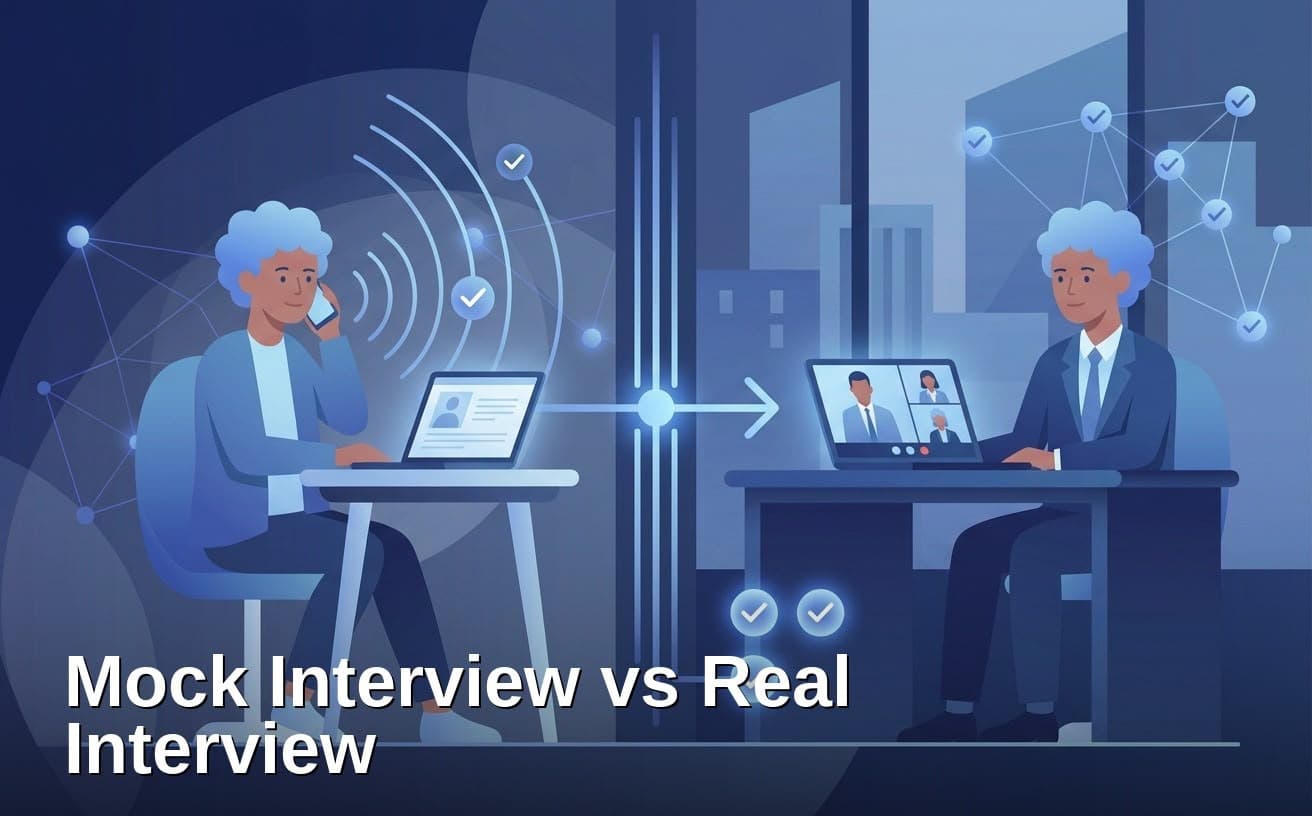
Mock Interview vs Real Interview — What's Different
Meta Title: Mock Interview vs Real Interview — Key Differences
Meta Description: What's actually different between a mock interview and a real one? Here's a breakdown of stakes, feedback, and how to get the most out of practicing.
Content: A mock interview and a real interview test the same underlying skills — clear communication, structured answers, relevant examples — but they differ in one critical way: stakes. A mock interview removes the consequences of a bad answer, which is exactly what makes it useful for improving.
Here's a closer look at what's actually different.
1. Feedback
In a real interview, you rarely find out why you didn't get the job. You might get a generic rejection email, or nothing at all. A mock interview is built around the opposite: the entire point is to tell you, specifically, what worked and what didn't — your clarity, your structure, whether your example actually answered the question.
2. Repetition
You get one shot at a real interview for a given role. A mock interview can be repeated as many times as it takes to fix a specific weakness — if you keep rambling on behavioral questions, you can run that exact scenario again until the structure becomes automatic.
3. Pressure, without the cost
Some pressure is useful — it's what makes practice transfer to the real thing. But in a real interview, that pressure is attached to something you actually want (the job), which can tip into anxiety that hurts performance. A mock interview keeps enough realism to be useful, without the cost of a wrong answer actually costing you an offer.
4. What stays the same
- The types of questions asked (behavioral, technical, role-specific)
- The expectation to structure your answers clearly
- The value of specific examples over vague generalities
- The importance of how you say something, not just what you say
Getting the most out of a mock interview
A mock interview is only as useful as how honestly you treat it. Treating it like a real interview — full answers, out loud, without pausing to "just think for a second" — is what makes the practice actually transfer. Treating it like a formality to click through defeats the purpose.
The goal isn't to get a perfect score in practice. It's to walk into the real interview having already made your mistakes somewhere that didn't cost you anything.
Ready to practice for real?
Try Mock Interview Training free on iPhone — voice or text practice, optional CV upload, and saved reviews.
Download app